Is Proton VPN Safe? Audits, Ownership and the Limits, Checked (2026)
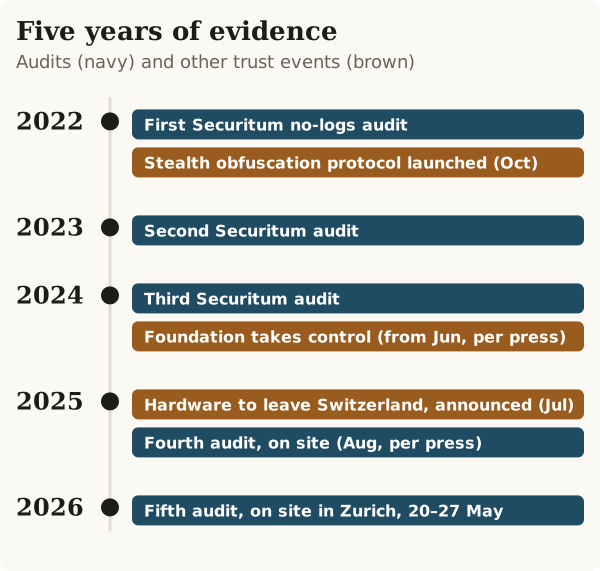
Yes, Proton VPN is safe for most people, and it is a legitimate company: Proton AG, based in Geneva and controlled by the non-profit Proton Foundation. Its no-logs policy has been audited on site by Securitum every year from 2022 to 2026, every one of its apps is open source, and its free plan carries the same no-logs promise as the paid ones. That is a stronger evidence base than most VPNs can show.
Safe is not the same as risk-free, though. Proton's servers keep data on encrypted disks rather than running only in memory, Switzerland's surveillance rules are in flux, and like any VPN it relocates the trust you'd otherwise place in your broadband company onto Proton rather than removing the need for trust. Below are the checks we'd make on any provider, applied to Proton with sources and dates. We read Proton's pricing page, audit page and privacy policy again on 18 October 2026.
The evidence at a glance
| Check | What we found | Verdict |
|---|---|---|
| Independent no-logs audit | Securitum, yearly since 2022; fifth audit on site in Zurich, 20 to 27 May 2026 | Strong |
| Open-source apps | All apps open source, including Windows, macOS, Android, iOS and the browser extension | Strong |
| Who owns it | Proton AG, Geneva; the non-profit Proton Foundation is the controlling shareholder | Strong |
| Server storage | Full-disk encryption on every server, not RAM-only | Mixed |
| Account data location | Encrypted, on Proton-run servers in Switzerland, Germany or Norway | Good |
| Android data sharing | Google Play listing: no data shared with third parties; independent MASA security badge | Good |
| Legal home | Swiss law; Proton is moving most hardware out of Switzerland over proposed surveillance rules | Watch |
The pattern is clear: Proton is strongest exactly where a no-logs VPN has to prove itself, in repeated outside audits and code anyone can read, and weakest on server design and legal uncertainty. Our no-logs VPN audit tracker puts these audit dates beside every other major provider's.
What five audits actually checked
A no-logs promise is worth exactly what its evidence is worth. Proton has hired Securitum, a European security auditor, to examine its VPN servers once a year since 2022. Proton says the auditors spend several days on site each time, reviewing server configurations and VPN configuration files, assessing operating procedures and interviewing staff. All five reports, 2022 to 2026, are linked from Proton's audit page and open to anyone without signing up.
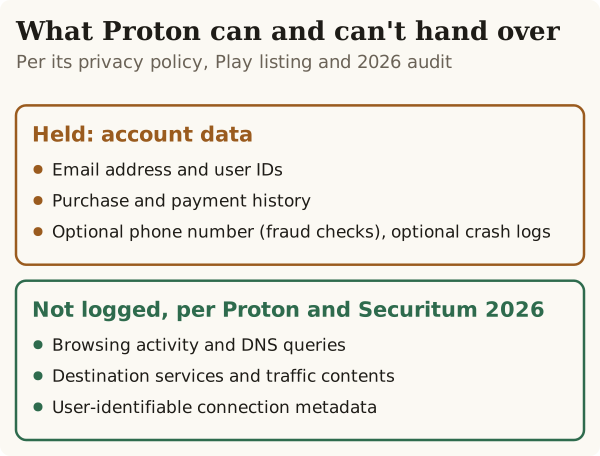
The 2026 report's conclusion, as Proton quotes it, is that the evidence reviewed "did not indicate that the examined Proton VPN server infrastructure logs users' browsing activity, DNS queries, destination services, network traffic contents or user-identifiable connection metadata", and that Securitum found no persistent records linking a specific user to activity on a reviewed server. Note the careful wording: an audit tests the servers and processes in front of the auditors during a set window. It is strong evidence, not a permanent guarantee, which is why the annual repeat matters.
Two other kinds of evidence back the audits up. Proton's apps are open source on every platform, so independent researchers can check what the software on your device does. And its Android app's Google Play listing, read on 9 October 2026, declares no data shared with third parties and carries the independent MASA security-assessment badge. What it does declare collecting is account-level: email address, user IDs, purchase history, an optional phone number for fraud prevention, and optional crash logs.
Who runs it, and is it legit?
Proton is a real, identifiable company with a long public record. Proton AG's terms name its office at Route de la Galaise 32 in Plan-les-Ouates, Geneva, and apply Swiss law, with Geneva courts, though US customers keep their own state's law and AAA arbitration. Proton says its controlling shareholder is the non-profit Proton Foundation, and press reports date that control to June 2024. A foundation-controlled owner has less pressure to monetise user data than a group that also sells advertising or runs review sites, a pattern our VPN ownership map traces across the industry.
Jurisdiction is where the picture has shifted. In July 2025, Proton announced that the bulk of its physical hardware would leave Switzerland, citing legal uncertainty created by proposed Swiss mass-surveillance rules. Its VPN privacy policy, last modified on 30 July 2025, says account data is stored encrypted on Proton-run servers in Switzerland, Germany or Norway, and that Proton physically owns all of its Secure Core servers and most of its VPN servers in Switzerland and Germany. Swiss law is no longer the whole story, and our 14 Eyes and VPN jurisdiction explainer shows why a provider's home matters less than what it can hand over.
The one public test of Proton's legal exposure involved Proton Mail, not the VPN. In September 2021 Proton confirmed it had complied with a legally binding order from Swiss authorities, which it had no way to appeal, in the case of a climate activist later arrested by French police. Its statement explains that under Swiss law it can be forced to collect information on a specific account under Swiss criminal investigation, never by default, and that it doesn't answer foreign governments directly. For a VPN user, the lesson is that only a no-logs design limits what such an order can reach.
The weak spot: disks, not RAM
Proton does not run RAM-only servers, and says so. It uses full-disk encryption on every server and argues that diskless operation offers no advantage. Providers such as ExpressVPN, Surfshark, Mullvad and Windscribe take the opposite view, running servers from memory so a seized machine holds nothing once powered off. Both designs aim at the same outcome. The difference is that encrypted disks depend on keys staying protected, while a RAM-only server has nothing to protect. If you weigh that heavily, our explainer on RAM-only VPN servers sets out both sides. It is a real difference, but not a reason to call Proton unsafe.
Is the free plan safe?
Yes. Proton's privacy policy says the free VPN is covered by the same no-logs policy as paid plans, and its free-plan page promises no ads and no data cap. That's the opposite of the business model behind many free VPNs, where your browsing pays for the service. The free plan's limits are practical rather than about safety: a single device connected at once, a random pick among 10 countries made by Proton, medium speed, and no streaming or P2P. Proton also reserves the right to slow free servers in cases of excessive use.
Settings that make it safer
Most risk with any VPN comes from configuration rather than the provider. Four settings are worth checking in Proton's apps.
- Use the stricter kill switch where you can. Proton's standard kill switch only blocks traffic if the connection drops by accident, not when you disconnect yourself. The advanced mode blocks everything outside the VPN and persists across restarts; it exists on Windows, the Linux app and, in beta, iOS. On Android, use the system's Always-on VPN with Block connections without VPN. Our VPN kill switch guide explains the difference.
- Re-enable protection after a Chromebook restart. Proton notes that on ChromeOS the Android app's always-on VPN and kill switch don't survive a reboot, so switch them back on, or suspend rather than shut down.
- Know how IPv6 is handled. Proton tunnels IPv6 on servers that support it, by default on Linux and Android and as an opt-in toggle on Windows, and disables IPv6 entirely on macOS and iOS to prevent leaks. A DNS and IP leak test confirms what your setup actually does.
- Use Stealth on hostile networks. Proton's Stealth protocol, available on every plan including Free, wraps the tunnel in TLS so it's harder for networks to spot and block.
Should you trust Proton VPN?
On the evidence, yes: five yearly on-site audits, open-source apps, a foundation-controlled owner and clear disclosure of where data sits make Proton one of the better-evidenced VPNs available. Choose it with open eyes about encrypted disks rather than RAM-only servers and about Swiss law still settling. If those two points are deal-breakers, Mullvad is a founder-owned alternative with its own run of audits and no affiliate program. If they aren't, you can see Proton VPN's free and paid plans (affiliate link; Proton's commission doesn't change this assessment). For what no VPN can protect you from, read our threat model.
Proton VPN safety questions
Is Proton VPN safe to use?
Is Proton VPN legit?
Is the free version of Proton VPN safe?
Does Proton VPN keep logs?
Can Proton VPN be forced to hand over data?
The through-line to everything here: a VPN shifts trust to its provider. See which no-logs claims are actually audited, or read the honest threat model.